TaskCall vs

PagerDuty is a recognized enterprise incident management platform. TaskCall Digital Operations is built for teams that want the complete digital operations workflow in one focused package: AI-powered triage, intelligent noise reduction, automated diagnosis, live call routing, runbooks, stakeholder communication, and AI-generated postmortems - without the add-on complexity that grows with every new capability you need.

Why teams choose TaskCall over PagerDuty

PagerDuty pioneered on-call incident management and has built a well-established enterprise platform over more than a decade. For teams operating at enterprise scale with mature procurement processes and dedicated tooling budgets, PagerDuty offers significant breadth. But for teams that want a complete, AI-enabled digital operations layer without navigating multiple add-on products, separate billing lines, and significant per-user cost increases at each tier upgrade, PagerDuty's complexity becomes a friction point rather than an asset. AIOps, live call routing, and runbook automation are not included in PagerDuty's base offering - they require separate add-on purchases that add procurement overhead and cost to every capability your team actually needs.

TaskCall Digital Operations is designed around a different premise: every capability an operations team needs to detect, triage, respond to, communicate about, and learn from incidents should live in a single, coherent platform. Incident response, on-call management, AIOps, intelligent noise reduction, automated diagnosis, live call routing, runbook automation, status pages, stakeholder communication, customer support visibility, and analytics are all part of the Digital Operations plan - not separate line items that require separate activation. Teams that move to TaskCall gain a complete operational workflow rather than a collection of separately licensed modules.

TaskCall's AIOps layer is designed to help responders at the moment they need it most. When a new incident fires, TaskCall's AI analyzes the triggering alert, correlates it against historical incident patterns and similar past incidents, identifies likely causes, and surfaces recommended resolution steps - before the on-call engineer has opened a single dashboard. Intelligent grouping suppresses related alerts from the same underlying issue into a single unified incident, reducing the number of separate notifications that fire during a high-volume alert storm. For teams managing complex distributed systems, the difference between arriving at an incident with AI-generated context versus arriving cold is the difference between a fast, focused response and a prolonged war room.

Live call routing and runbook automation are two capabilities where TaskCall's packaging model creates a clear operational advantage. PagerDuty treats both as add-ons, meaning teams must evaluate, purchase, and configure them separately from the core platform. TaskCall includes both in the Digital Operations plan. Live call routing ensures that on-call engineers receive a real inbound phone call when an alert fires - not just a push notification that can be silenced by Do Not Disturb. Runbook automation gives responders access to predefined diagnostic and remediation steps at the moment of incident creation, reducing the cognitive load of response under pressure. Both capabilities are live from day one with no additional procurement required.

60% Better Pricing on Every Plan

TaskCall's Digital Operations plan costs up to 60% less than comparable PagerDuty plans and includes AIOps, live call routing, and runbooks without separate add-on purchases. Teams that need the complete operational toolkit do not face escalating add-on costs every time they need a capability their on-call operations actually depend on.

AIOps Native to Digital Operations

TaskCall's AIOps capabilities - intelligent grouping, likely cause analysis, resolution recommendations, past similarity matching, and AI postmortem generation - are built into the Digital Operations plan. PagerDuty's AIOps features require add-on activation. TaskCall makes AI a native part of the incident workflow, not a separate product layer to purchase and configure independently.

Live Call Routing Included

PagerDuty offers live call routing as an add-on, adding per-user cost for a capability that is essential for reliable after-hours alert delivery. TaskCall includes live call routing in the Digital Operations plan. On-call engineers receive real inbound phone calls when alerts fire - no add-on required, no additional activation needed.

Runbooks Without the Add-On

Runbook automation in PagerDuty requires a separate add-on purchase. TaskCall includes runbook support in the Digital Operations plan, giving responders access to predefined diagnostic and remediation steps from the moment an incident is created - with no additional activation or billing required at any team size.

From Detection to Postmortem in One Platform

TaskCall covers the complete incident lifecycle: AI-powered detection and grouping, automated diagnosis, incident response, stakeholder status communication, and AI-generated postmortems that turn every incident into a structured learning event. PagerDuty covers much of this workflow, but across multiple product layers and add-on configurations. TaskCall delivers it as a single, coherent operating model.

Intelligent Noise Reduction in the Digital Operations Plan

Alert fatigue is one of the leading causes of on-call burnout. TaskCall's intelligent noise reduction groups related alerts from the same underlying cause into a single incident, suppresses known flapping signals, and filters low-value notifications before they reach the on-call queue. The result is fewer interruptions per real incident and a cleaner, more focused response experience.

AIOps Built Into the Digital Operations Workflow

PagerDuty has strong AIOps capabilities. The difference between the two platforms is not whether AI exists - it is how each platform packages AI into the incident workflow. PagerDuty's AIOps features - intelligent alert grouping, probable origin analysis, related incidents, past incident correlation, and event orchestration - are powerful, but they exist as a separate product layer that requires add-on activation. For many PagerDuty customers, AIOps is not part of their default configuration because it requires a separate purchase that sits outside the core subscription they already pay for. Teams that skip it operate without the noise reduction and diagnostic context that makes AI-assisted incident response effective.

TaskCall's AIOps is native to the Digital Operations plan. When a new incident is created, the AI layer activates automatically: it analyzes the triggering alert, cross-references it against similar past incidents, identifies likely causes ranked by confidence, and surfaces recommended resolution steps for the on-call responder. Intelligent grouping runs continuously across all incoming alert traffic, collapsing related signals from the same underlying issue into a single unified incident. AI-generated postmortems compile the full incident timeline - alert history, acknowledgement records, responder actions, and resolution notes - into a structured draft that teams review and annotate rather than build from scratch. For engineering teams that want AI to be part of every incident response by default, TaskCall's approach delivers that outcome without a separate purchasing decision standing between them and the capability.
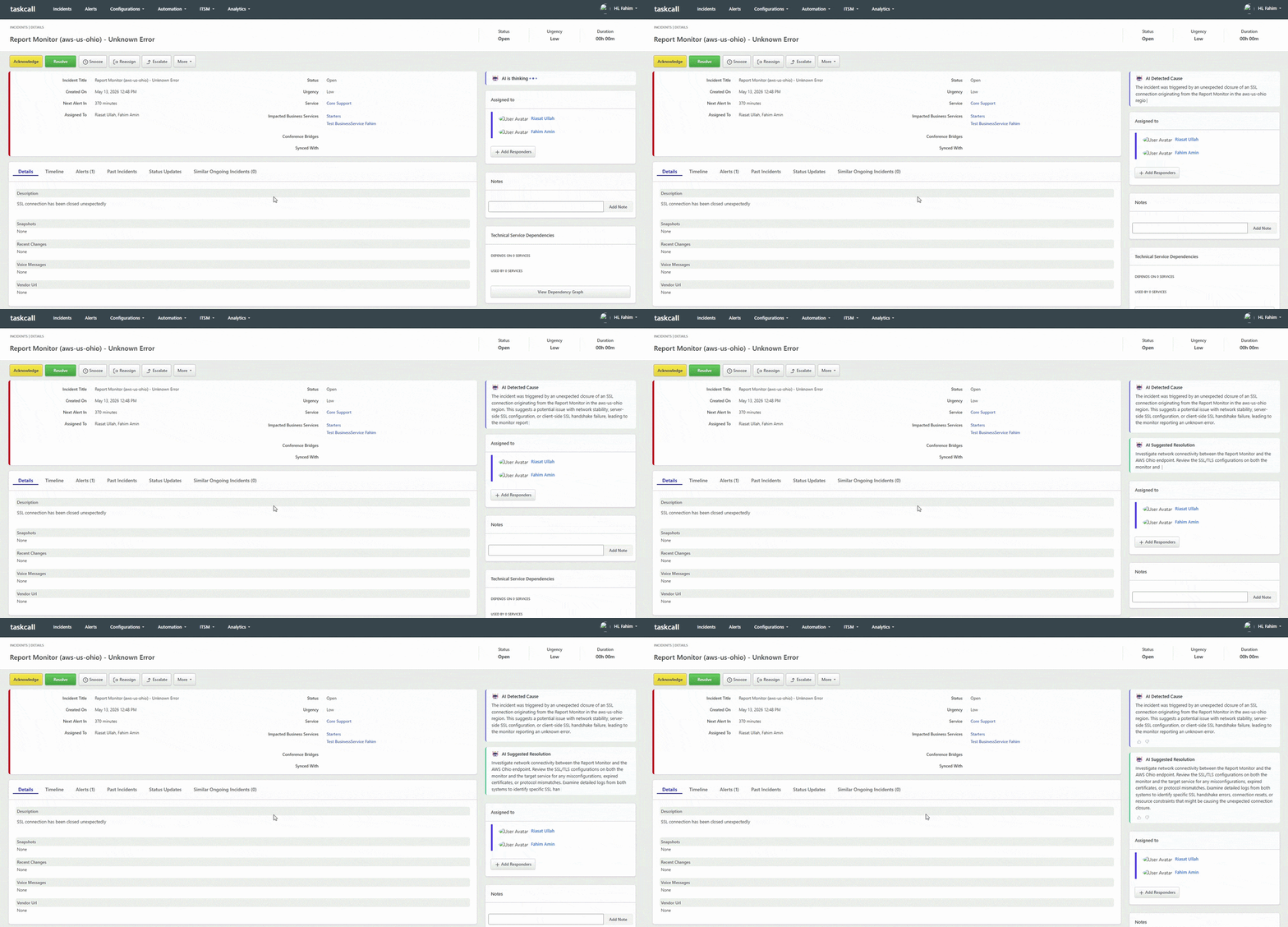
TaskCall AIOps showing intelligent cause analysis, and resolution recommendations for an active incident

Live Call Routing and Runbooks: Included, Not Add-Ons

When an alert fires at 2 AM, the delivery mechanism matters. A push notification can be silenced, missed in a notification stack, or blocked by Do Not Disturb. A real inbound phone call cannot. Live call routing is one of the highest-impact capabilities in any incident management platform because it closes the gap between alert delivery and engineer acknowledgement during off-hours when response time is most critical. PagerDuty offers live call routing, but it requires an add-on purchase that adds per-user cost to an already significant base subscription. For teams that need it - which is every team with an on-call rotation - that add-on cost is not optional. It is a recurring requirement that compounds as the team scales.

TaskCall includes live call routing in the Digital Operations plan. There is no separate activation, no per-feature billing, and no minimum seat threshold before the capability becomes accessible. When an alert fires and the first on-call engineer does not acknowledge within the configured timeout window, the escalation policy advances and the next engineer receives a call - automatically, without manual intervention. Runbook automation works the same way: predefined diagnostic and remediation steps are attached to incident types at configuration time, and when a matching incident fires, the runbook is surfaced immediately in the incident timeline. Responders arrive with the full diagnostic context already prepared rather than searching for documentation under pressure during an active outage.
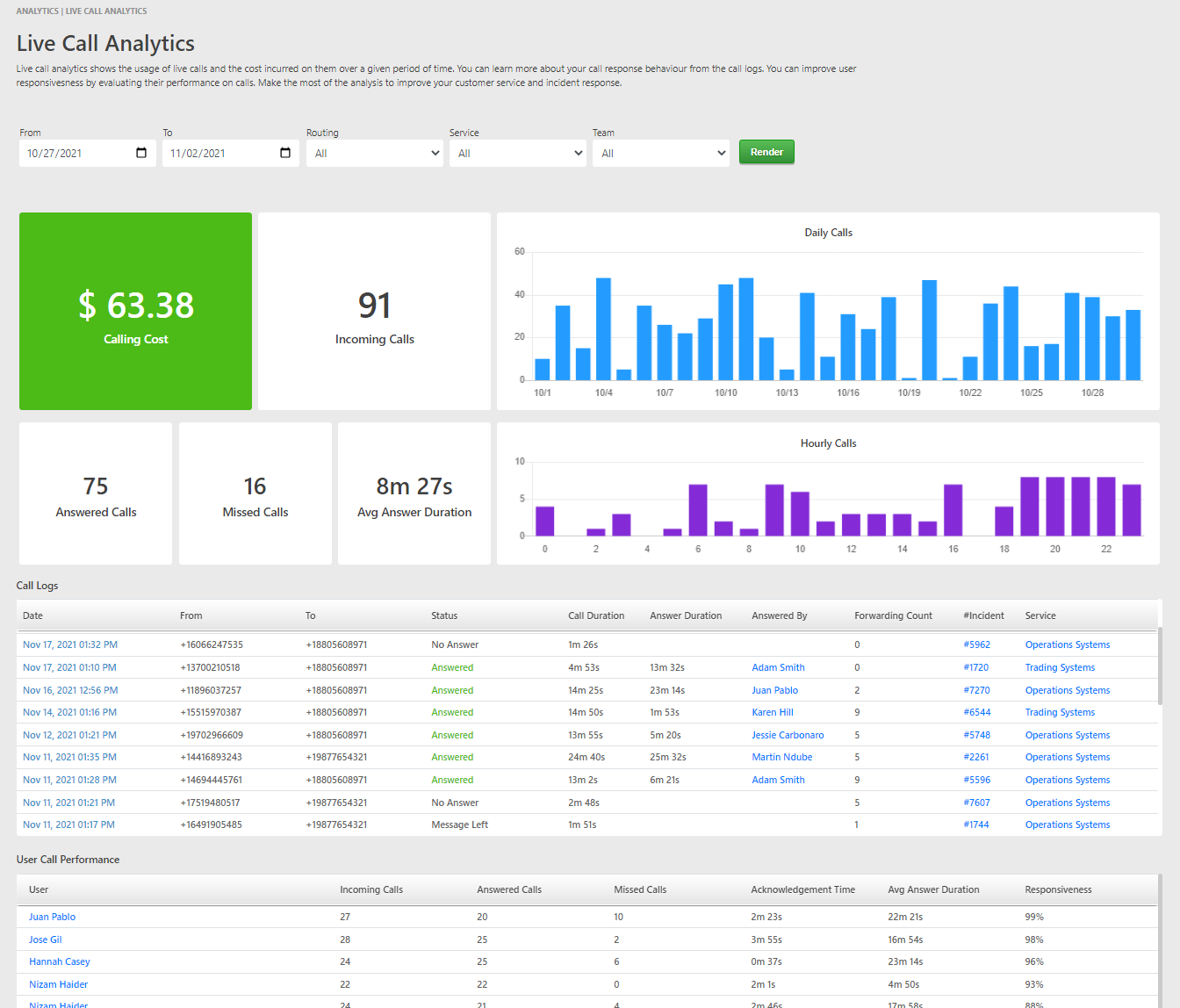
TaskCall live call routing page

Complete Digital Operations: From Alert to Postmortem

The most compelling argument for TaskCall over PagerDuty is not any single feature - it is the end-to-end operational story that TaskCall's Digital Operations plan supports as a single, coherent workflow. Detection, noise reduction, AI-assisted triage, automated diagnosis, responder mobilization, live call delivery, runbook execution, stakeholder status communication, customer support visibility, and AI-generated postmortems are all part of the same operational loop. Teams do not need to configure multiple products, manage multiple billing relationships, or navigate separate admin interfaces to access the full capability set. Everything from the moment an alert fires to the moment a completed postmortem is published is managed within one platform.

PagerDuty offers much of this capability across its Operations Cloud platform, but the breadth of PagerDuty's product portfolio also introduces operational complexity for teams that are not running large, dedicated site reliability or operations teams to manage the toolchain itself. TaskCall's focused platform is designed for operations teams that want enterprise-grade capabilities without enterprise-scale tooling overhead. PagerDuty is the right choice for organizations with the scale and resources to leverage its full portfolio. TaskCall is the better choice for teams that want a complete incident operations workflow - AI-powered triage, intelligent noise reduction, automated diagnosis, incident workflows, real-time analytics, stakeholder communication, branded status pages, and continuous learning through postmortems - in a more direct, end-to-end platform.
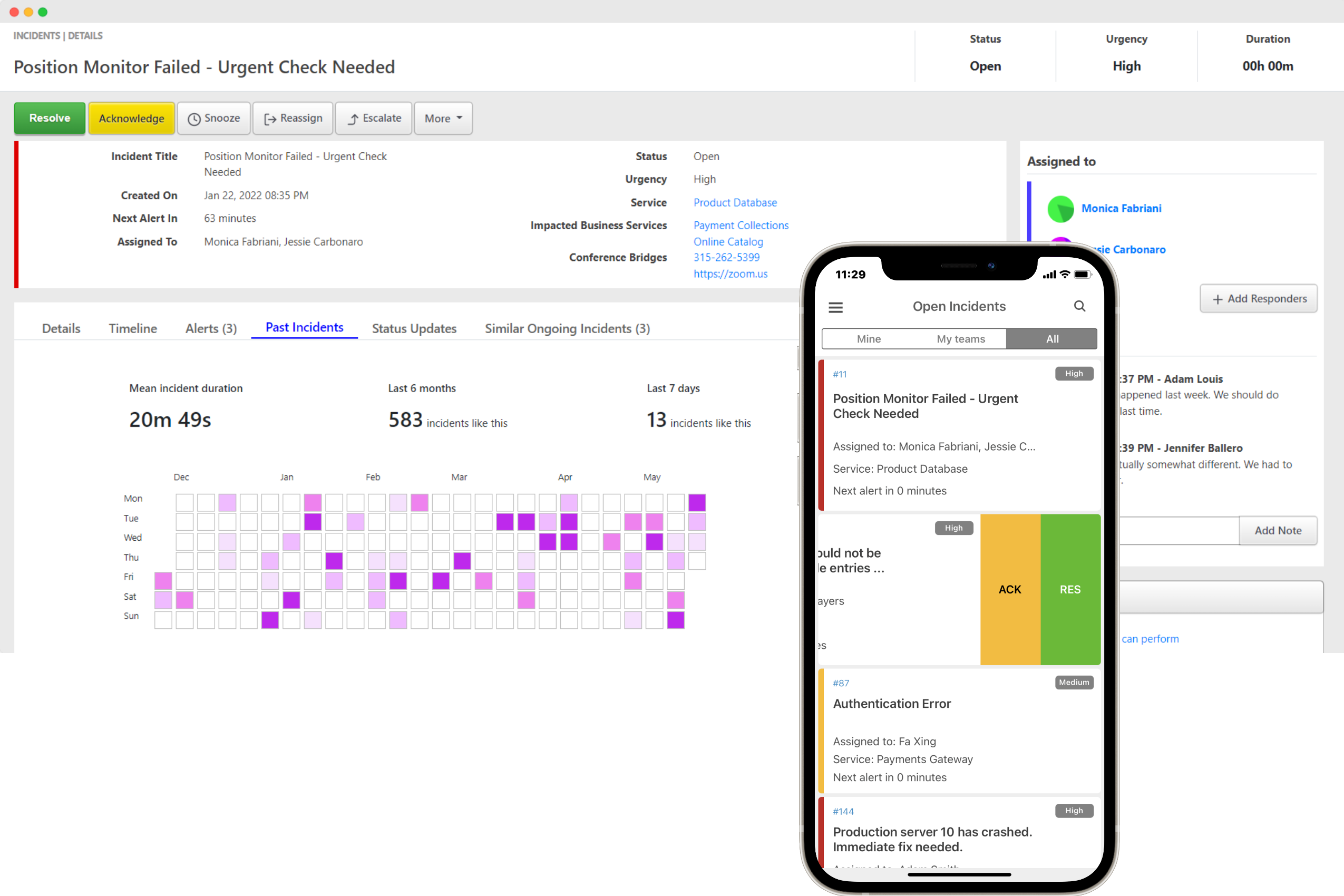
TaskCall incident timeline showing incident details

TaskCall vs PagerDuty: Feature Comparison

A side-by-side look at what each platform offers across core incident management capabilities.

TaskCallPagerDuty
60% Better Pricing on Every Plan TaskCall costs up to 60% less than PagerDuty across all comparable plans - with AIOps, live call routing, and runbooks included, not sold as add-ons.
AIOps AI-powered alert grouping, likely cause analysis, resolution recommendations, and intelligent noise reduction. (Add-on)
Live Call Routing Route alerts as real inbound phone calls to on-call engineers. (Add-on)
Runbook Automated runbook execution and diagnostic step surfacing at incident creation. (Add-on)
Incident Workflows Structured incident response workflows covering detection, triage, escalation, and resolution.
Status Pages Public and private status pages for real-time stakeholder communication during incidents.
On-Call Management Flexible on-call schedules, rotation management, and override support.
Analytics and Insights Built-in operational analytics covering MTTA, MTTR, alert volume, and on-call load trends.

Get the complete digital operations platform.

AIOps, live call routing, runbooks, intelligent noise reduction, AI postmortems, and status pages - all in one plan.
No add-ons. No surprises. Switch to TaskCall today.

Start Free Trial
The Cheapest PagerDuty Alternative

A detailed breakdown of the top PagerDuty alternatives ranked by price, features, and ease of migration. Find the best fit for your team size and budget.

Read more >
Incident Response: A Digital Solution

How modern engineering teams structure their incident response workflows to reduce downtime, improve reliability, and keep stakeholders informed in real time.

Read more >
On-Call Management for Modern DevOps

A deep dive into how high-performing DevOps teams manage on-call rotations, reduce alert fatigue, and maintain engineer well-being during sustained incidents.

Read more >

Don't lose money from downtime.

We are here to help.
Start today. No credit cards needed.

81% of teams report response delays due to manual investigation.

Morning Consult | IBM
Global Security Operations Center Study Results
-- March 2023