Opsgenie vs PagerDuty: Comparison & Better Alternatives
While Opsgenie and PagerDuty both aim to streamline alerting and incident resolution, they differ in features, integrations, pricing, and user experience. This makes it important for teams to evaluate which platform fits their operational needs best.
Teams have around 15 months before OpsGenie's shutdown timeline affects them. While PagerDuty appears to be the leading alternative, most teams are put off by the 2-3x price increase. This raises an important question: do you find a platform that offers the same features at a fair price, or do you accept the cost increase?
Current Status: What You Need to Know
OpsGenie
Launched in 2012, OpsGenie was purchased by Atlassian for $295 million in 2018. Feature development has stopped since the acquisition. According to Atlassian, all users must migrate by Q3 2026 to ensure a seamless transition as the platform will close in April 2027. The deadline for data export is March 2027.
- Price: $9-29 per user/month
- Status: Shutting down April 2027
- Integrations: Approximately 300
- Support: Degrading as shutdown approaches
Core Capabilities:
- Alert aggregation from monitoring tools
- On-call schedule management
- Escalation policies
- Mobile alerts (SMS, push, voice)
- Basic incident tracking
- Integrations with Jira, Confluence, ServiceNow
PagerDuty
Founded in 2009, PagerDuty services over 19,000 clients, including Fortune 500 businesses. PagerDuty adds new features quarterly to the platform, and all product lines continue to be actively developed.
- Price: $21-61 per user/month
- Status: Active development, publicly traded (NYSE: PD)
- Integrations: 700+
- Support: Email to dedicated CSM depending on tier
Core Capabilities:
- Advanced alert management with AIOps
- Sophisticated on-call scheduling
- Full incident management lifecycle
- Status page management (integrated)
- Live call routing
- Customer service operations (add-on)
- Advanced analytics and business intelligence
- Response automation and workflow orchestration
How OpsGenie and PagerDuty Actually Compare
Pricing Reality
For a 20-user team:
- OpsGenie Standard: $380/month ($19 × 20)
- PagerDuty Professional: $820/month ($41 × 20)
- Annual difference: $5,280
OpsGenie's comparable tier is less expensive by 2.3x than PagerDuty's Essentials price ($21/user/month). OpsGenie's Standard package is 2.1 times less expensive than the Professional tier ($41/user/month). When comparing enterprise tiers, the pricing difference becomes even more pronounced.
Alert Management
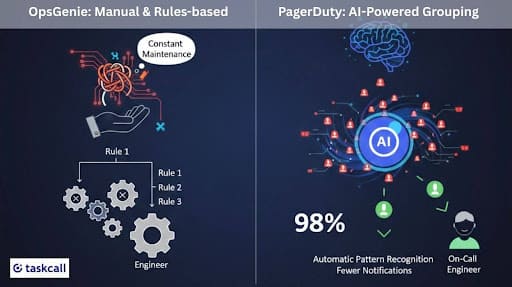
OpsGenie employs manual deduplication together with simple rule-based routing. The system routes in accordance with the rules you create and the alerts that match them. It functions, but it demands ongoing rule maintenance.
According to PagerDuty's stated statistics, PagerDuty uses AI-powered alert grouping to reduce alert noise by up to 98%. On-call engineers receive fewer notifications as a result of the system's automatic pattern recognition and grouping of relevant warnings.
On-Call Scheduling
Both platforms handle the time-zone support and standard rotation management. OpsGenie offers simple schedule generation with override possibilities.
Schedule templates, mobile editing, and more precise override options are all added by PagerDuty. Not only does the mobile app support alarm response, but it also enables complete schedule control.
Incident Management
OpsGenie uses a straightforward timeline view to track occurrences. Stakeholder communication and documentation are still done by hand, but you can see what happened and when.
From the initial alert through resolution and post-event review, PagerDuty oversees the whole issue lifecycle. The platform offers automated stakeholder updates, incident commander assignment, and organized post-mortems as key features. According to statistics from IBM's Global Security Operations Center Study, this cuts the amount of time teams spend coordinating incidents by about 27 minutes per event.
Status Pages
A separate Statuspage.io subscription is needed for OpsGenie. Managing two platforms and manually coordinating updates between them will be your task.
The fundamental platform of PagerDuty incorporates status page capabilities. Status pages can be automatically updated by incidents without extra configuration.
Integration Ecosystem
OpsGenie supports about 300 connectors, including critical monitoring tools (Datadog, New Relic, AWS CloudWatch), ITSM platforms (ServiceNow, Jira), and collaboration tools (Slack, Microsoft Teams).
More than 700 integrations with richer, bidirectional sync capabilities are available with PagerDuty. The platform offers more comprehensive context passing across systems as well as bespoke webhook transformations.
The cloud infrastructure and basic monitoring tools that the majority of teams use regularly are integrated with both platforms
Why Teams Look Beyond Both Platforms
The OpsGenie Problem
It is necessary to migrate. Within the next 15 months, every OpsGenie user must switch to a new platform. This presents many difficulties:
Complexity of data export: Teams must extract and migrate analytics and historical incident data.
Integration reconfiguration: Reconfiguring integration is necessary for all monitoring tools, ITSM platforms, and communication channels.
Investment in training lost: The team's years of experience with OpsGenie workflows do not transfer to new platforms.
Support deterioration: Response times lengthen, and problem-solving slows down as the shutdown draws near.
The PagerDuty Challenge
For most teams, the 2-3x cost increase causes financial difficulties. A 50-person operations team that presently pays $11,400 annually for OpsGenie Standard would pay $24,600 yearly for PagerDuty Professional, a $13,200 annual increase.
The sophisticated functionalities of PagerDuty are not utilized by many teams. Rarely do small to mid-size businesses (10–100 employees) require the complete enterprise features that support premium pricing. They are paying for items that they won't utilize, such as enterprise compliance certifications, customer service operations add-ons, and advanced business intelligence.
At higher tiers, PagerDuty demands yearly commitments, making it challenging to scale down if needs change.
What Operations Teams Actually Need
- Reliable alerting: 99.9%+ uptime without enterprise-tier pricing
- Core on-call management: Rotations, escalations, and override handling
- Essential integrations: Connections to monitoring tools, ITSM platforms, and communication channels teams already use
- Responsive support: Direct access to people who can solve problems, not just ticketing systems
- Active development: Regular updates and new features, not a platform approaching end-of-life
Migration Alternatives Worth Evaluating
TaskCall: Enterprise Features at Startup Pricing

Without the high cost of PagerDuty, TaskCall provides teams with the incident management features they want. The platform was created for teams moving from outdated systems that require extensive capabilities at affordable prices.
Core capabilities:
- On-call scheduling with rotations and overrides
- Incident response with full lifecycle tracking
- Live call routing for critical alerts
- Workflow automation and response playbooks
- Integrated status pages
- AIOps alert grouping and noise reduction
- MTTX metrics and team performance analytics
Pricing structure:
- Starter: $9/user/month
- Business: $19/user/month
- Digital Operations: $29/user/month
TaskCall's Business plan pays $380 per month for a 20-person team. It is the same as OpsGenie Standard but offers long-term viability and active development. The same team on PagerDuty Professional saves $5,280 annually by using TaskCall instead of paying $820 every month.
Dedicated account manager support is included in all TaskCall plans. PagerDuty reserves specialized support for Enterprise tier clients; neither OpsGenie nor PagerDuty provides this similar price range.
Integration support includes:
- Cloud platforms: AWS, Microsoft Azure, Google Cloud
- Monitoring: Datadog, Splunk, SolarWinds
- ITSM: Jira, ServiceNow
- Collaboration: Slack, Microsoft Teams
- Customer support: Zendesk
- Error tracking: Sentry
TaskCall provides dedicated onboarding for OpsGenie migrations, including integration setup assistance and data migration guidance. Teams can test the full platform with a 14-day trial before committing.
Start your 14-day TaskCall trial
Here are some other Platforms to consider.
Squadcast ($9-21/user/month)
SRE-focused platform with a developing integration library and competitive pricing. Ideal for smaller companies that value technical depth and SRE teams.
Incident.io (~$35/user/month)
For Slack-native teams, a contemporary interface was created. Compared to specialized incident response platforms, this platform has strong incident coordination features but less powerful alerting functions.
Splunk On-Call (VictorOps)
Splunk ecosystem integration for enterprises. Pricing is comparable to PagerDuty. Ideal for companies who have already made infrastructure investments in Splunk.
ilert
European platform with EU data residency and a GDPR-first strategy. For teams with stringent data location needs, this is a good choice.
Planning Your Migration
Timeline
- Q1 2025: Complete platform evaluation
- Q2 2025: Run trial systems (2-4 weeks per platform)
- Q3 2025: Execute full migration (4-6 weeks)
- Q4 2025: Buffer period for refinement
- Q3 2026: OpsGenie recommends completion by this date
Migration Checklist
- Document current setup: Export all alert routing rules, on-call schedules, and escalation policies from OpsGenie to document the existing configuration.
- Integrations for audits: Enumerate all of the ITSM platforms, monitoring tools, and communication channels that are currently in use.
- Export past information: Before the deadline of March 2027, download the incident history, analytics, and team settings.
- Test substitutes: During trial periods, run parallel systems to verify functionality.
- Make an integrated migration plan: Give top priority to essential first-phase connection monitoring tools.
- Plan the cutover: Have a rollback plan ready and schedule the changeover during times when there are few incidents.
Avoid Common Mistakes
- Rushing without proper testing
- Underestimating training time
- Not running parallel systems during transition
- Forgetting to update external documentation
- Skipping data export until too late
Make the Decision
By April 2027, OpsGenie users will have to migrate. Where to relocate is more important than whether to relocate at all.
Teams with enterprise budgets and a need for sophisticated capabilities can use PagerDuty. The majority of small to mid-sized teams (10–100 members) don't require the complete enterprise capabilities that warrant the two–to three-times higher expenses.
Enterprise-grade incident management at prices similar to OpsGenie's legacy costs is what TaskCall offers as a compromise. The platform offers the essential functionality that operations teams utilize on a daily basis without charging for services they don't require, and it has specialized support at every tier.
Start evaluating your options now. Teams starting trials in Q1 2025 will have 15 months to make well-informed judgments and carry out seamless migrations before OpsGenie shuts down. Teams that hold off until 2026 will have to deal with hurried installations and weak vendor negotiation leverage.
FAQs
What is the main difference between Opsgenie and PagerDuty?
PagerDuty is an end-to-end incident management platform, while Opsgenie is described as a highly customizable alerting tool with deep integration into the Atlassian ecosystem.
How does the price of Opsgenie compare to PagerDuty?
Opsgenie is ideal for smaller teams or those who prioritize cost because it typically provides a more affordable entry point with transparent, tiered pricing, frequently starting cheaper than PagerDuty's initial charges, particularly for basic alerting and scheduling.
Who are PagerDuty's competitors?
PagerDuty's main competitors in IT incident response and AIOps include Opsgenie, Splunk On-Call (VictorOps), xMatters, BigPanda, Datadog, and Moogsoft.
What are Opsgenie and PagerDuty's integration capabilities?
Opsgenie is appropriate for teams that are currently utilizing the Atlassian ecosystem because it supports more than 200 tools and closely integrates with Atlassian products like Jira and Confluence. PagerDuty combines many technologies to expedite incident response and supports more than 700 connectors, such as Splunk and ServiceNow.
You may also like...
Learn 10 incident management best practices to reduce MTTR, improve response times, minimize downtime, and keep teams aligned during critical IT incidents.
Use incident management KPIs and metrics, such as MTTR, MTTA, and response times, to monitor what really matters to improve uptime, accountability, and expedite issue resolution.